

KARL BOUDREAULT AWARD
for Leadership in Evaluation.
The Karl Boudreault Award for Leadership in Evaluation recognizes those who have made a significant contribution to our evaluation community and have demonstrated leadership at local, national and/or international levels.
A Leadership Award in Evaluation was introduced in 2003 and first awarded at the 2003 Annual Learning Event.
In 2004, the CES-NCC Board of Directors unanimously passed a motion to dedicate the award to Karl Boudreault, an active Chapter member who had passed away the same year.
Past recipients
Michael Obrecht
Simon Roy
Isabelle Bourgeois
Jennifer Birch-Jones
Edward Jackson
Martine Perrault
Alexandra Dagger
Shelley Borys
Heather Buchanan
Gerry Cooney
Brad Cousins
François Dumaine
Benoît Gauthier
Katherine Graham
Michel Laurendeau
Steve Montague
Nancy Porteous
Emily Brennan
Nelson Jean-Francois
Nominations
In memory of Karl Boudreault, we are looking to recognize those who have made a significant contribution to our evaluation community and have demonstrated leadership at local, national and/or international levels.
Do you know a CES-NCC member (individual or group involving a team of evaluators) with demonstrated success in:
Mentoring, coaching and teaching evaluation
Building strong evaluation community networks
Service to the Chapter or Chapter events
Innovative and constructive thinking and contributions to the work of evaluation
You may nominate an individual or group by completing this form. The award will be presented at the CES-NCC Annual Learning Event. See the policy and process for recognizing leaders in our community.
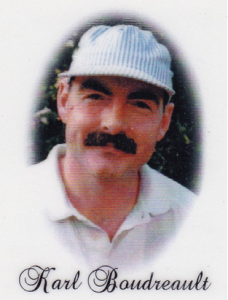
Karl Boudreault
“Free spirit and huge passion for life.”
– Jim Gilroy of Goss Gilroy Inc.
We lost Karl far too early at the age of 45. We honour his spirit and his passion for evaluation through this dedication of the Karl Boudreault Award for Leadership in Evaluation.
Karl attended the Université Laval for his Bachelor of Social Science degree, specializing in Economics. He then went to the Université du Québec à Hull for a Master of Science degree, where he was awarded the Governor General’s Gold Medal for academic performance.
Karl worked in eight different federal government departments in his 22-year career and the majority of his work life was spent in evaluation positions:
1981: Economist, Fisheries and Oceans
1982–1984: Human Resources Analyst, Department of the Secretary of State
1984–1986: Human Resources Analyst, Customs and Excise
1986–1989: Senior Analyst, Employment and Immigration, Legislated Employment Equity Program
1989–1991: Senior Evaluation Officer, Indian Affairs and Northern Development
1991–1994: Senior Evaluation Manager, Indian Affairs and Northern Development
1994–1995: Manager, Integrated Registration, Department of Revenue
1995–1997: Senior Evaluation Manager, Foreign Affairs and International Trade
1997–1998: Senior Analyst, Audit, Evaluation and Review, Treasury Board Secretariat
1998–2002: Acting Director, Program Evaluation and Review, Treasury Board Secretariat
2002–2004: Senior Evaluation Manager, Department of Veterans Affairs
Karl sat on the CES-NCC Board of Directors as the Treasury Board Secretariat (TBS) representative while working at TBS from 1997 to 2002. Karl forged stronger links between our Chapter and TBS, notably in organizing joint professional development opportunities for the membership. He was dedicated to the notion of continuous learning.
But that is just the factual history. More important, is how and what he contributed to the evaluation community. For that we have to look at the man who he was.
Karl’s passion for life was also a passion for evaluation. Karl held strong opinions and liked nothing better than a good strong debate on concepts and issues. But he enjoyed the debate not for the sake of argument or to be right and persuasive in his position (although that was often the case) – but more for the opportunity to learn and to look at a situation or issue from a new point of view. He was always delighted and energized when he was convinced of new point of view!
This passion would also present as controversial and Karl enjoyed – no revelled – in being controversial. Here again, Karl was rarely thinking ‘in-box’ – I am not sure he knew a box existed, which could prove challenging in the ‘political’ life of public service.
Karl was a strategic thinker, but quite pragmatic and very visual. Anyone who met with him in his office can attest to a heavy reliance on the white board, which always contained some diagram or model depicting a problem and a solution – with the mandatory arrows connecting the pieces of the puzzle. He and I solved many a problem with table napkins over lunch.
His vision for evaluation included greater recognition for the profession and its contributions, notably within government. He worked towards this vision and had little patience for evaluation work that ended up collecting dust on the shelf. He believed this to be the responsibility of the evaluator and the evaluation community: To create an environment and undertake evaluation work in a manner, which led to useful and used results.
Karl defined success in evaluation, not in the results provided in reports, but as he said: “Indicators of success include, not only the implementation of recommendations, but the elimination of surprises for the client, as results are integrated into the organization, even before the publication of the final report.” He considered examples of such collaborative efforts to be his greatest success as an evaluator. Humour was also high on the list of competencies Karl believed you needed in evaluation and in life.
Perhaps even more importantly, Karl actively mentored and coached those new to the profession. Sharing his knowledge, skill and experiences was second nature, something he did with great ease and competency.
Karl described his own management style, which he credited to his father, Gaston, as – “my management is characterized by the provision of the maximum possible freedom and support to professionals and employees, the use of every success and error as a learning opportunity, and constant investment in the development of each team member.” – a quote I stole from his CV.
But instead of being the usual resume self-promotion rhetoric, this was truly how Karl operated in the business environment. Karl had no problem with delegation, as he did not fear error. Those who personally benefited from this kind of supportive and developmental management style, Aileen Pangilinan and Fabio Onesi for example, recall the beauty and the challenge of this freedom – of “being thrown in and completely allowed to run with it.” You were really able to learn from doing, making mistakes and succeeding, with Karl not for him.
Karl’s starting premise and assumption was that regardless of position or level, you had something to contribute and something that he wanted to hear or know. He exemplified this by being what is often not given sufficient credit – a good listener.
He felt the strength of our profession was in bringing new people into the field, to keep us challenged and to continually insert fresh perspectives to the field. He truly enjoyed mentoring, coaching and sharing his experience.
Another part of his contribution to our community lies in this keen interest in sharing knowledge and his active network building. The relationships and connections he facilitated are many. Karl would often find commonalities between his circle of colleagues and friends and initiate new connections.
To this end, he was a very strong supporter of the Canadian Evaluation Society and was a member of both the NCC and PEI Chapters. His focus within these Chapters was often on creating opportunities for those in the profession to learn, from each other and from more formal, organized training events. He introduced many to the Society.
Karl defined success in life through his relationship with his partner, Johanne and his three children, Marc-Antoine, Camille and Laurent – and through his strong ties with his father, Gaston and three sisters, Anne, Marie-Claude and Myriam as well as his many friends.
We are dedicating this award – the Karl Boudreault Award for Leadership in Evaluation – to recognize others who also demonstrate these skills, talents, and characteristics. He is sorely missed!
Heather Buchanan
Past-President
Canadian Evaluation Society, National Capital Chapter